

Option A
Drum Brakes
The long-established, cost-effective braking solution.
Best for: Best for rear wheels on economy vehicles and light-duty applications where heat buildup is less of a concern.
Option B
Disc Brakes
The modern, high-performance standard for consistent stopping power.
Best for: Best for front wheels on most vehicles and all four corners on performance, larger, or heavier vehicles demanding reliable stopping.
How Each System Generates Stopping Force
Both drum and disc brakes work by converting your vehicle's kinetic energy into heat through friction - but the way each system applies that friction differs significantly.
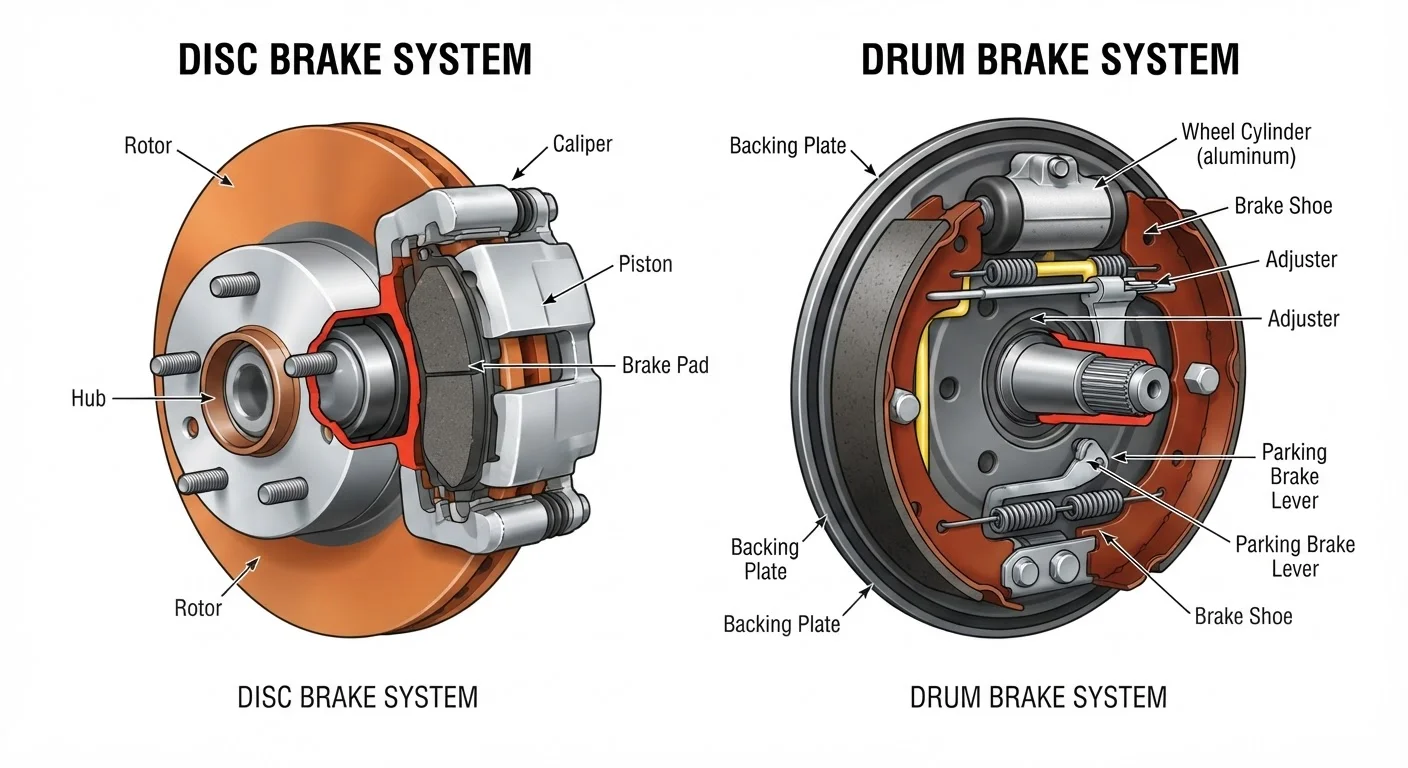
Drum brakes use a hollow metal drum that rotates with the wheel. Inside the drum sit curved brake shoes lined with friction material. When you press the brake pedal, hydraulic pressure pushes the shoes outward against the interior surface of the spinning drum. That contact creates friction and slows the wheel. Because the drum encloses the entire mechanism, heat generated during braking is largely trapped inside.
Disc brakes work on an open rotor - a flat, circular metal disc that spins with the wheel. A caliper straddles the rotor and contains one or more pistons. Brake fluid pressure forces the pistons to squeeze flat brake pads against both faces of the rotor simultaneously. The open design allows heat to radiate and dissipate quickly into the surrounding air.
| Criterion | Drum Brakes | Disc Brakes |
|---|---|---|
| Friction mechanism | Shoes press outward against drum interior | Pads clamp against flat rotor faces |
| Heat dissipation | Poor - heat trapped inside drum | Excellent - open rotor radiates heat |
| Resistance to brake fade | Lower under sustained use | Higher under sustained use |
| Wet weather recovery | Slower - water trapped inside | Faster - open rotor sheds water quickly |
| Manufacturing cost | Lower | Higher |
| Typical component lifespan | Shoes last longer (less load) | Pads wear more frequently |
| Ease of inspection | Requires drum removal | Often visible without full disassembly |
| Parking brake integration | Simple - uses existing shoes | Requires added mechanism |
| Common placement | Rear axle on economy vehicles | Front axle on nearly all vehicles |
Performance, Heat, and Brake Fade Explained
Heat management is where the two systems diverge most meaningfully for drivers. Brake fade occurs when excessive heat reduces a system's ability to generate friction - meaning the harder and more often you brake, the less effective the brakes become until they cool down.
Because drum brakes trap heat inside an enclosed housing, they are more susceptible to fade during repeated heavy stops - think mountain descents, stop-and-go traffic in a loaded vehicle, or aggressive driving. Disc brakes, with their exposed rotors, shed heat rapidly, maintaining more consistent performance under those same conditions.
Disc brakes also perform better in wet weather. Water on a drum brake's interior surfaces can temporarily reduce friction before the shoes squeeze it away. Open disc rotors shed water faster, typically recovering full braking performance within one or two brake applications.
60-70%
Braking force absorbed by front brakes
Weight transfer during braking shifts load forward, which is why front disc brakes became the industry standard across virtually all vehicle categories.
~150,000 mi
Potential lifespan of rear drum brake shoes
Because rear drum brakes handle a smaller share of braking load, shoes in low-stress rear applications can last significantly longer than front disc pads under normal driving conditions.
Where You'll Find Each System on Modern Vehicles
The distribution of brake types on today's vehicles reflects a practical compromise between cost and performance demands. Understanding what your vehicle has - and where - helps set realistic maintenance expectations.
- Front axle: Almost universally disc brakes on modern passenger vehicles, since the front brakes absorb 60-70% of braking force during a stop.
- Rear axle: Varies. Many economy sedans and compact cars still use rear drum brakes to control costs. Midsize and larger vehicles, trucks, SUVs, and performance cars typically use rear disc brakes.
- All four corners: Increasingly common across the broader vehicle market, especially as manufacturing costs for disc systems have declined.
One reason rear drums persist: the enclosed drum naturally accommodates a mechanical parking brake using a secondary set of shoes or a lever. Engineering an equivalent into a rear disc setup requires an additional mechanism - either a small drum integrated into the rotor hat, a separate drum-in-hat design, or an electronic parking brake actuator.
Drum-in-Hat: A Hybrid You May Not Recognize
Some vehicles with four-wheel disc brakes use a design called drum-in-hat, where a small drum brake is machined into the center of the rear rotor specifically to serve as the parking brake. If a mechanic mentions this during a rear brake service, it means your vehicle technically has elements of both systems at the rear. This design is worth understanding because it adds a separate set of shoes and hardware that require periodic inspection alongside the main disc brake components.
Maintenance Differences and What to Watch For
Knowing which system your vehicle uses helps you anticipate service intervals and costs.
Disc brakes use pads that typically need replacement more frequently than drum brake shoes - roughly every 25,000-65,000 miles depending on driving habits and pad compound, though your owner's manual and a qualified mechanic should guide actual intervals. Rotors must also be inspected for thickness and scoring; worn rotors are replaced or, in some cases, machined smooth. The accessible design makes inspection relatively straightforward.
Drum brakes use shoes that often last longer - sometimes 150,000 miles or more in rear applications - because they absorb less of the total braking load. However, the enclosed drum can accumulate brake dust and moisture, and inspecting shoe wear requires wheel removal and drum disassembly. Springs, adjusters, and wheel cylinders inside the drum are additional components that can wear or corrode over time.
If you notice pulling to one side, a grinding or scraping noise, a spongy brake pedal, or increased stopping distances, have your brakes inspected by a qualified mechanic promptly. Do not delay brake service - brake system integrity is directly linked to vehicle safety.
The content on this site is provided for informational purposes only and should not be considered a substitute for professional advice. While we strive to provide accurate and up-to-date information, we make no guarantees regarding its completeness or accuracy. Always consult a qualified professional for advice specific to your circumstances before making any decisions.